So much to do, so little time.
Early childhood educators are feeling pressure to pay more attention to foundational academic skills in addition to all of the other dimensions of development that are important in early childhood–and at the same time they know that children need time to play. Fitting it all in is a challenge.
One strategy to expand children’s learning opportunities is to provide parents and other caregivers with the tools they need to create a learning environment at home. Most caregivers have gotten the message that it is important to read to their young children. Math is trickier. Caregivers need more guidance in how they can engage their young child in math activities that will help prepare them for the math they will encounter in kindergarten.
The DREME website has a whole section describing math activities for young children, many of which can easily be integrated into daily routines and many of which are in Spanish. But telling parents to go to the website is enough; parents are very busy and may not be used to looking for guidance on the web. Trusted teachers, however, can engage parents as math teaching partners without a lot of effort, using some of the activities on the DREME website.
Preschool teachers regularly send things home with children, usually in their backpacks – notices, children’s art and the like. How about adding some materials and suggestions for math activities that they can do at home?
Below are some suggestions. (It might be best to do these activities at school before you send them home, so the children are familiar with them.)
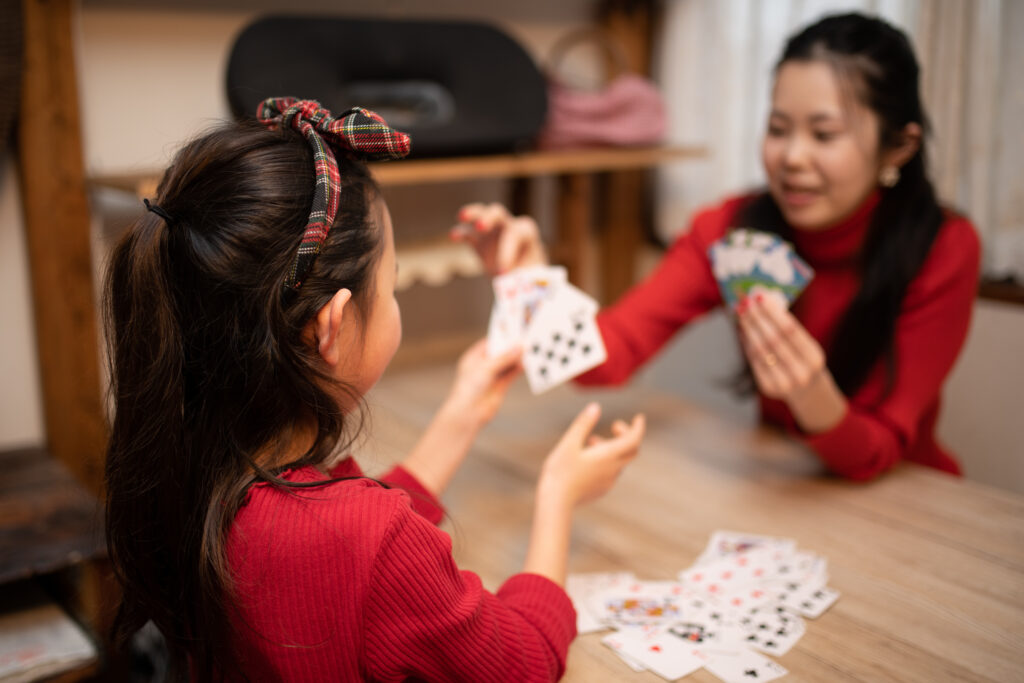
- Send home a deck of cards. (I have seen them on Amazon for $1 a deck, so it shouldn’t put a big dent in your supplies budget.) Include instructions for a simple game. First, take out the face cards and divide the remaining deck into two, one for a caregiver (or sibling) and one for the child. Both players turn over a card and the child has to figure out who has the highest number by counting the pictures and comparing the two cards. The player with the highest number keeps the cards. You keep playing until one person has all the cards. It can be made easier by taking out the high-number card (e.g., playing with just ace (=1) through 5) or harder by playing two cards that the child has to add together.
- If you have any of the many books described on the DREME website in your classroom or school library, send them home with children with the storybook guide on the website – to help caregivers talk about math while they read the story (without interfering too much with the story!).
- Send home instructions for Simon Says with lots of math. Caregivers are likely to know the game already and just need some suggestions for how to integrate math into it.
- Copy and send home a “math snack” like the ones below – perhaps one a week. These are activities caregivers can engage in while doing what they need to do, anyways. After a few weeks, caregivers are likely to get the general idea and begin to build their own math conversations into their everyday routines.
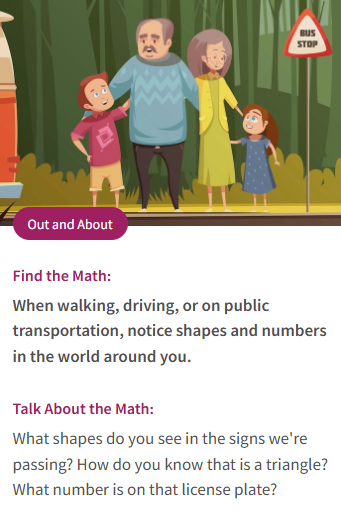
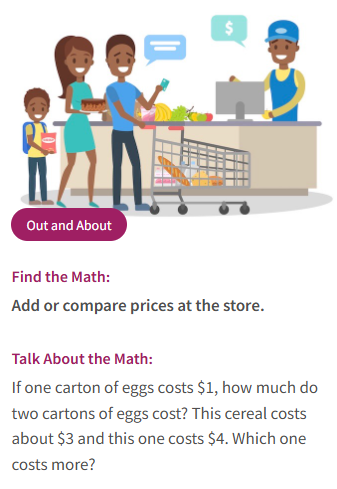
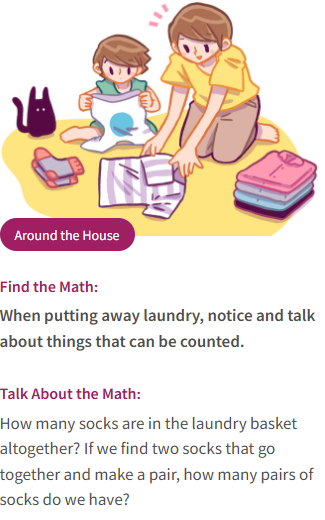
- Scavenger hunt is another game that can be played at home It’s a good keeping a young child occupied while the caregiver is cooking dinner or walking the child to school.
The DREME website also has family math kits on sorting, shapes, measurement, patterns, and counting that require inexpensive materials and can be assembled and sent home with instructions printed from the website.
And of course, there are activities that you do with your children in your class that could be shared with parents.
Most parents don’t need to be convinced that they can help their children learn – they just need a little guidance. Many may be reluctant to engage in math, in part because math anxiety is common. But all they need is a little nudge and some good ideas for fun activities that they can build into hectic days, such as things to do that can be easily integrated into their daily routines. Helping them see that math around them, in the spaces they frequent (e.g., the playground, the kitchen, grocery store, on a walk) should stimulate their own thinking about how to make math a regular part of their children’s lives at home.