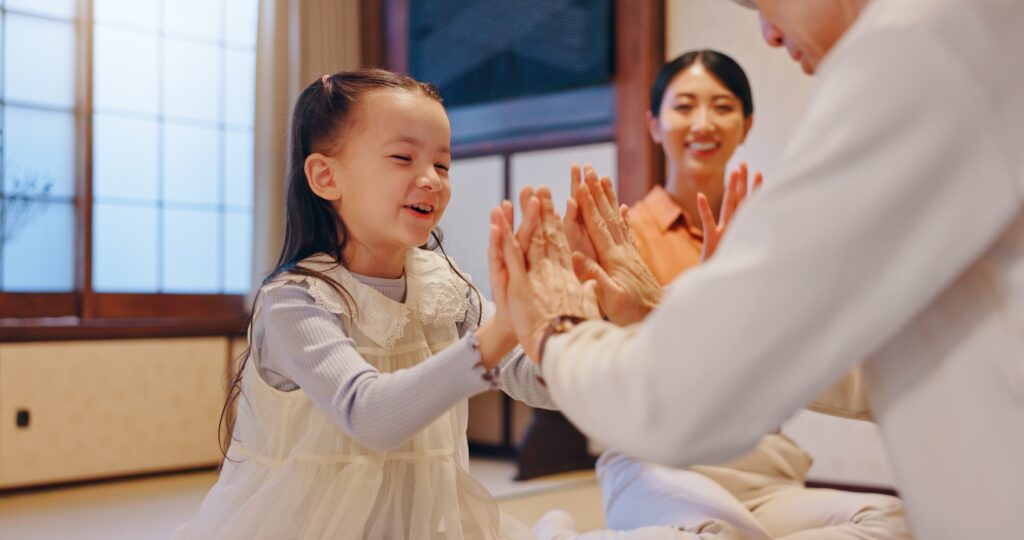
Sometimes, brief glimpses of children’s behavior can provide valuable insights into their mathematical minds. I like to call these “Zen Math Moments.” Here’s an example: one morning, Emily decides to give a clapping concert for the amusement of her kindergarten friends. Watch and listen and re-watch and re-listen to this video of Emily’s remarkable performance.
So many things to observe in these 30 seconds!
- Her fast clapping seems to be patterned. There is some repetition, but the pattern is not simple. Only after watching this video many times and slowing it down did I see that there is more than one pattern, and that some variations may be imperfect. Emily seems to be changing patterns in midstream. A kind of jazz performance.
- Her clapping is music—”good music,” as her appreciative fans exclaim.
- Her music is expressed in body movements as much as it is in sounds. It is embodied music.
- I didn’t ask her, but no doubt Emily cannot articulate the various pattern(s) underlying her clapping. (I couldn’t either).
Yet, she spontaneously attempts to mathematize her music—that is, to interpret the music through the lens of math. Around the 18 second mark, she begins to count a repetitive part of her clapping, not single claps, but a patterned cluster of claps within the larger whole. She counts 8 such clusters, begins to count again, but then stops as she collapses from musical fatigue.
In brief, Emily’s embodied clapping/music contains patterns. They may be shifting and imperfect, but they are patterns, nonetheless. Emily cannot describe them, but she must be aware of them as she puts on her mathematician’s hat to count them.
If Emily pursues a musical career, she will learn about the conventional and explicit written math of music, including rational number, as in half notes and quarter notes, as well as ascending and descending patterns of notes, and much more.
There is a little mathematician inside all children, regardless of their interests. Many children who enjoy clapping patterns can also learn about the math underlying them with some guidance from an adult. If you have children who love music, but experience difficulties or express a disinterest in math, creative play like clapping patterns can help make math more accessible.
Here are some tips so you can begin to teach children about the math behind music:
- Find some clapping games on YouTube. Click here for a link to four games.
- Discuss the patterns during and after gameplay. This will help children to make direct, mathematic connections from their informal, implicit math ideas.
- For example, in the video of Miss Mary Mack, you can begin—as does the adult in the video—by explicitly describing the pattern in numerical terms, the number of taps. You can also discuss what comes at the outset of the sequence and what comes later, as well as whether the notes are getting “higher” or “lower.”
- Ask open-ended questions about the activity. “What do you do first? And then what? How many times do we do it? What else do you notice about the taps? What if you were teaching a friend how to play this tapping game?”
- Continue engaging with the patterns in your child’s day-to-day life. DREME has great resources for you to do this! Click here to view a DREME clapping activity and a general discussion of patterns.
Next consider a moving musical picture, a Dynamic Visual Representation (DVR) of music created by an obscure influencer named Johann Sebastian Bach.
Listen to the music as you observe its DVR. Click here for a full performance.
What do you notice? I notice a few things:
- Bach is at least as good as Emily at creating patterns of music. Baroque beauty!
- Patterns are essential to music.
- The music is visually and emotionally moving.
(More about DVRs of music in another blog post.)
Overall Zen insight: children love good music. They have a deep, non-verbal, and embodied understanding of its mathematical patterns. Thanks to this, you can use music to help them learn math and math to help them learn music.
Finally: If you have any queries or comments, you can always contact my sensei, Professor Ginsboo, at profginsboo@gmail.com, who will be delighted to respond.
More finally: Want to learn more about children’s music and understanding patterns? See chapters 33 and 34 in Professor Ginsburg’s book, Young Children’s Amazing Math (2025).