Sometimes a very short episode of children’s behavior can enlighten you about their mathematical minds. Here is one such Zen Math Moment. To understand it, watch and listen and re-watch and re-listen to these two video episodes.
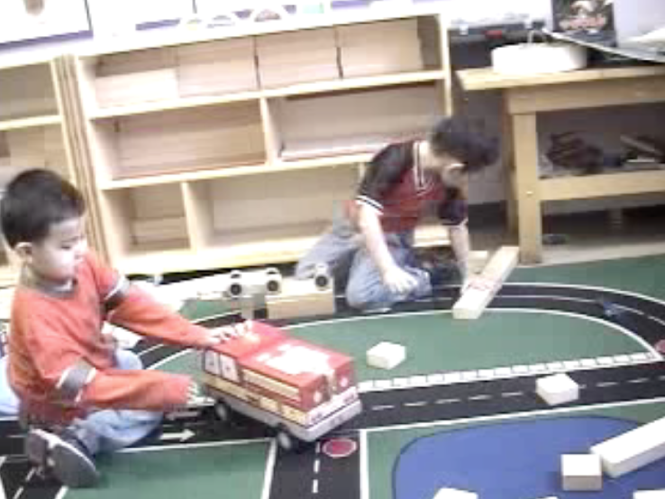
One day, Milo (on the left) is playing with a fire truck in the block corner. The other child, Ricardo, wonders, “Where is another truck?” searches, and finds one. Milo immediately proclaims that his fire truck is “bigger.” To prove it, he compares the two trucks side by side. After that, he places the fire truck next to another, upside-down truck and again asserts that his truck wins the size competition.
But Ricardo does not give up. He holds up a long block (a “rectangular prism”) and claims that it is “bigger” than Milo’s fire truck. He then lays the block on the floor, with the left end of the block more or less in line with the left end of the truck, and the right end sticking out beyond the truck. This shows that the block is also “longer” than the truck. Milo then moves the truck to a vertical position, but that doesn’t help: Ricardo points out that the block is “still bigger.”
So much went on in these first 37 seconds.
- The boys are enjoying their unsupervised truck and block play.
- At first, Milo is concerned with “bigger than.” He means overall bigger than, just as we might say that a dinosaur is bigger than a mouse, without referring to height or weight or any specific dimensions.
- Ricardo then uses the long block to introduce the idea of measurement along a single dimension, length or height.
- Ricardo uses the word “bigger” to refer to height (the vertical dimension) and “longer” to refer to length or width (the horizontal dimension.)
- The boys believe that “bigger than” and “longer than” are more desirable attributes than “smaller than,” or “shorter than.”
Their play involves thinking and language components. Milo begins with a general concept of overall size and then Ricardo introduces informal measurement. The boys use imprecise but effective language to express their thinking.
It’s also important to understand that their play is embedded in emotion and motivation. The boys enjoy their play and compete, clearly preferring bigger/longer/wider/more as opposed to smaller/shorter/narrower/less of whatever dimension is involved. Their play provides an everyday, informal precursor to precise measurement.
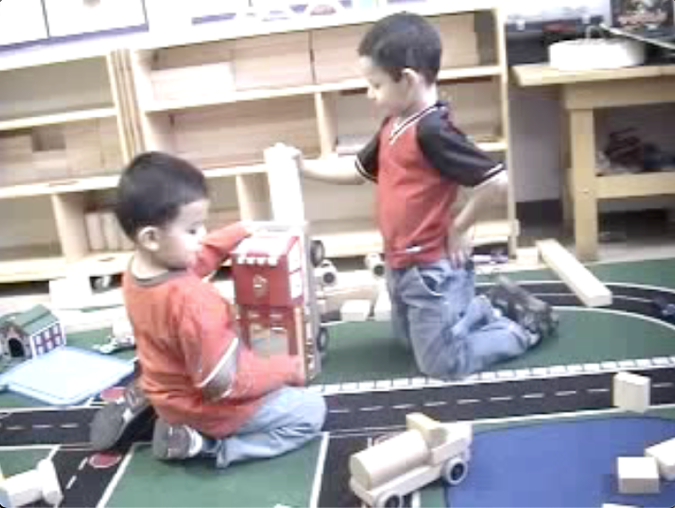
The boys then decide that they can make something “bigger” than the initial long block. Ricardo gets another block and tries to put it on top of the first. Milo gets two blocks and tries to put one on top of the other while he is sitting down! Ricardo wants to make the unsteady structure even taller and tries to put a third block on it, as he boasts about having “three,” three idiosyncratic units of measurement. The boys argue about whose structure is “bigger,” but eventually Milo concludes with the friendly (face saving?) observation that they both have “the same size.”
All of this is the first step on the road to precise measurement.
But the story is not over. At the end, the blocks get revenge for the interruption of their leisure: one block falls and hits Ricardo on the head and, for some reason I cannot determine, Milo says “Ow!” and clutches his side.
Overall Zen insight:
The origins of measurement lie in everyday life, in the imprecise comparison of various common objects. Why do children compare? Because they generally want more rather than less (more food, play time, screen time, and so on). Informal measurement develops in the context of egotistic desire and lays the foundation for precise measurement.
Here are some tips for helping:
- Give children blocks and similar materials to play with and construct as they please.
- Talk about what they have built. Ask them to describe and explain their construction.
- Depending on what they have built, challenge them to make something a little more complex or different in an important way.
- Read storybooks about measurement. Several are discussed in DREME, for example, “Room for Bear”.
- You may also benefit from other DREME materials on measurement. They explain what children need to learn about measurement, give examples of children’s thinking about measurement, and discuss how you can help them.
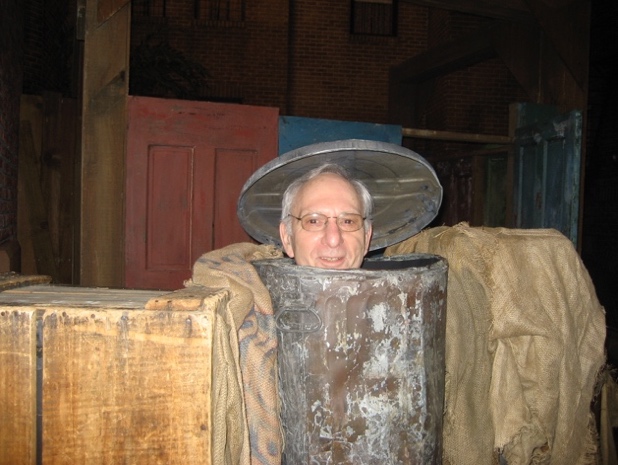
Finally: If you have any queries or comments, you can always contact my sensei, Professor Ginsboo, at profginsboo@gmail.com, who will emerge to respond to your email. He particularly recommends this resource on measurement.
More finally: Want to learn more about children’s ideas about measurement? See chapter 13 in my book about Young Children’s Amazing Math (2025).