
Sometimes a very short episode of children’s behavior can enlighten you about their mathematical minds. Here is one such Zen Math Moment. To understand it, watch and listen and re-watch and re-listen to this video episode.
Dylan has been building tall block tower. Next to him is Viola the Volunteer, a high school student who occasionally helps out in this Kindergarten. She has been building a tower right next to his.
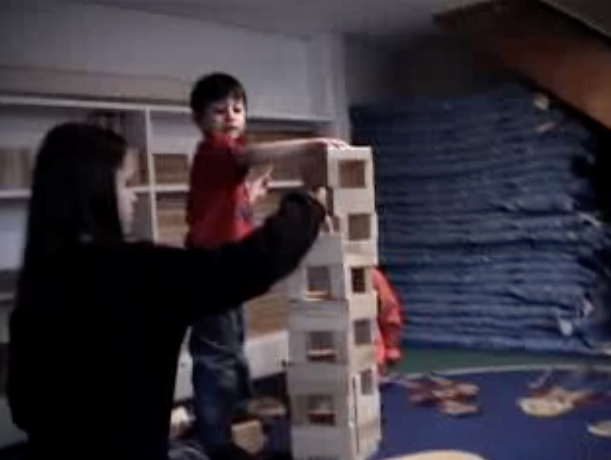
The sound is hard to make out, but Dylan begins by saying (roughly), “Mine’s the King’s tower. You can’t build yours bigger than mine’s because mine’s is the King’s.” Viola replies that her tower is the Queen’s. When Dylan points out that her tower is “littler,” Viola uses the opportunity to help him develop correct mathematical language, commenting that it is “shorter.”
Dylan then points to a spot just a little above Viola’s tower and shorter than his, as he says, “That’s how high it’s going to be.” Viola acknowledges that she has a very limited building permit: “Just a little bit higher.”
Dylan approves, “That’s good. Mine is bigger than yours,” and Viola confirms her tower’s inferior status again inserting more precise mathematical language: “Yours is higher.” (Note too that the sitting Queen is less elevated than the standing King.)
At this point, a classmate who has been watching the royal construction comments, “‘Cause yours is the King.”
Dylan is extremely happy. He seems to count the number of imaginary levels his tower, the King’s, rises above Viola’s, the Queen’s. He is enormously impressed with his construction and with himself, uttering something like, “Wow….”
What should we make of all this? On the one hand, it is clear that Dylan’s block construction involved basic ideas of everyday math. He was obviously concerned with height differences in the towers and clearly wanted the higher, just as all young children generally prefer more to less, bigger to smaller, huge to teeny, and the like. His tower (and Viola’s too) was constructed very carefully, with precise use of blocks of different sizes and shapes arranged in various patterns. Dylan even mathematized the number of imaginary levels (5) that his tower rose above the Queen’s.
But I want to stress something else. The block building activity and the interactions around it show that early in children’s development, everyday math may be embedded within a sexist culture. As Dylan builds, he asserts his King-like position. He relegates the Queen to an inferior status. He towers (sic) over her. The King’s construction must be higher than the Queen’s. And by extension, a boy’s tower should be larger than a girl’s. I have even observed that sometimes boys try to keep girls out of the block area entirely. And that’s not the end of it: sexist attitudes like Dylan’s often carry over to adulthood.
Overall Zen insight:
Everyday math does not develop in a vacuum. Babies learn about more and less in the context of wanting or not wanting food. Children learn about pattern as they hear music. Children learn about measurement as they play with blocks. At the same time, children’s block play and the everyday math underlying it may be embedded in the sexist stereotypes that boys are generally better than girls in math. But this is not true: In fact, research shows that boys and girls have roughly the same math abilities at the outset. Here’s a non-technical reference. So don’t be influenced by sexist stereotypes, or any other prejudices. Think of children first as individuals, not as members of a group.
There are many wonderful opportunities for parents and teachers to promote equitable math learning in boys and girls.
Here are some tips for helping:
- Understand that you don’t have to abide by a culture’s sexist stereotype concerning boys’ superiority in math learning. Why should boys be the Kings and girls subservient Queens? Get that nasty stereotype out of your head. Banish the King and the Queen too. All boy and girl commoners can learn math.
- Make sure that girls in the classroom and girls at home have the opportunity to play with blocks, Legos, and other toys sometimes considered appropriate for boys only. Don’t assume that some toys but not others are gender appropriate. Encourage the girls to play in block area and boys in the dress-up area.
- Read storybooks that explore girls’ math abilities and learning. Here is a storybook guide from DREME about a young girl’s passion for math.
- Get boys involved in the math of cooking, which is too often considered primarily a female domain. This DREME activity can help you.
- More generally, as children, regardless of gender, are engaged in block play (and other activities too), talk with them about what they are doing and why they are doing it. Insert precise mathematical language, the way Viola did, and use the language of size, shape, measurement, and other aspects of Everyday Math. Encourage children to use this language too.
Finally: If you have any queries or comments, you can always contact my sensei, Professor Ginsboo, at profginsboo@gmail.com, who will emerge to respond to your email.

More finally: Want to learn more about girls’ early math abilities? Read about Cassie the young engineer in chapter 30 in my book Young Children’s Amazing Math (2025).