Sometimes a very short episode of children’s behavior can enlighten you about their mathematical minds. Here is one such Zen Math Moment involving counting. Watch and listen to this (poor technical quality) video of Stanley and friends.
One morning, during free play, Stanley, around 5 years of age, is sitting at a table where he is counting some small objects. I am not sure what they are. As the video begins, he proclaims that he has 100 of what I will call “thingees.” Then he starts to count them, “One, two, three…”
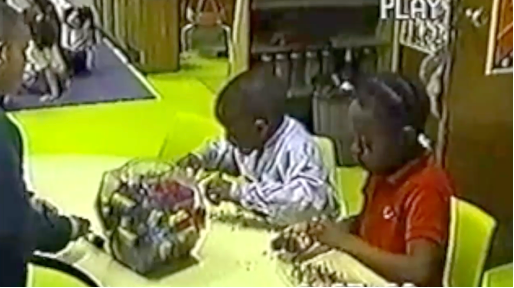
Stanley Counts
When he reaches “nine” the girl sitting next to him joins by counting her own collection of thingees, which she has just dumped from a box. Together, they reach “eleven” where I have made a break in the video to avoid boring you. In fact, they continued to count one by one, and as the video resumes, they are at “fifty-seven.” They go on, correctly counting to “sixty-five” as a fight breaks out among several girls who want to get in on the action. At this point the video skips to where Stanley is bravely counting on in the 80s, as the fight escalates. He ignores the chaos, continues counting, even as he drops a thingee, and eventually reaches one hundred. A girl standing next to him counts along and at the end announces proudly and at full volume over the chaos, “one hundred!” Stanley then proclaims, “We all got one hundred!”
What should we make of this? One might think nothing much of interest has happened. Stanley likes to count and does so, more or less accurately, up to one hundred. Boring?
No. What is noteworthy is Stanley’s motivation, influence, and persistence.
- Stanley initiates the counting of thingees, on his own, during free play when he could have been doing something else.
- Stanley voluntarily sets a challenging goal of counting to 100. That’s a lot of thingees. He wants to go high. He is impressed with big numbers.
- Stanley is an influencer: his example inspires other children to join him in this mathematical activity, although instead of counting, some go more or less berserk.
- Stanley is engaged, persisting throughout the chaos engulfing his mathematical endeavors.
- He is triumphant: reaching his goal brings a lot of satisfaction.
All of this suggests that before schooling and during its early years:
- young children may enjoy engaging in everyday math,
- may choose to do it on their own,
- do not need to be forced to do it,
- and may even persist in doing it despite obstacles that may arise.
This is incredibly important. Math does not have to be a subject evoking fear and boredom in children, teachers, and parents.
Imagine this: Stanley is now a senior in high school. During free period, he decides to do some calculus problems like the following:
- Find all real values of \(x\) that satisfy the following eleventh-degree polynomial equation: \((x+1)^{11}-x^{11}-1=0\)
Senior Stanley totally enjoys the challenge of solving calculus problems, particularly challenging ones. Nora, the girl sitting next to him, decides to solve the problem as well. Then several other classmates arrive and start arguing among themselves about who might take the seat next to Stanley and Nora and join them in working on the calculus problem. Eventually, after a great deal of intense thought and calculation, they all reach the solution at the same time and proclaim in unison, “We all got . Isn’t math wonderful!”
A totally realistic scenario?
This kind of enthusiasm for math is difficult to find among students who have had years of learning that math is hard and boring. If I had escaped this downward motivational trajectory when I was learning math, I wouldn’t have had to consult AI for a good calculus problem and its solution that I could show to you.
Overall Zen insight:
It’s possible for young children to enjoy math and persist in doing it. The key question is whether and how the educational system can extend the enjoyment throughout formal education.
Tips:
The insight raises the question of how teachers and parents can promote children’s positive attitudes toward math and desire to persist in learning it. Here I discuss what can be done for young children, strategies that can be adapted to later grades.
- Provide an environment in which children can engage in their everyday math activity and learning. The environment at home and school should include blocks, paper and pencil, puzzles, toys, and the like.
- Encourage children to explore, play with and enjoy these materials, either on their own or with others. Your role is to turn the children loose and encourage their play. Give them adequate time to do their thing or to figure out their own way to solve a problem. Encourage them not to give up quickly when they don’t know what to do or get a wrong answer. Provide minimal help. In general, don’t correct or teach, although….
- Here’s the hard part: there may be some occasions when you do need to provide help – such as by giving hints or suggestions or even direct instruction. You have to keep a balance between letting the child persist in doing their own thing and providing help when they need it. Start with open-ended questions like, “What are you trying to do?” Then maybe, give a hint or suggest a strategy. On a few occasions you may even have to instruct (“no, don’t count any of the blocks twice”). But avoid giving direct instruction too often because it takes away the child’s opportunity to experience personal success.
- Check out a very useful DREME blog post on promoting positive math attitudes.
Finally: If you have any queries or comments, you can always contact my sensei, Professor Ginsboo, at profginsboo@gmail.com, who will emerge to respond to your email.
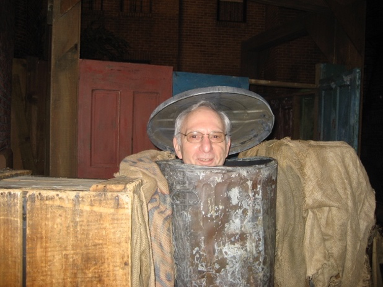
More finally: Want to learn more about children’s persistence in the everyday math activity of building a castle? See chapter 30 in my book Young Children’s Amazing Math (2025). Also, chapter 42 advocates for adult “relaxed patience” in dealing with children’s everyday math.
Wait! Not finished yet. My sensei informs me that a former Kindergarten teacher, Julie Diamond, has important comments on the Stanley episode. Here they are:
| I want to expand on how teachers can apply the Tips. What kind of classroom environments are likely to promote the kind of joyful and focused engagement that Stanley displays? First, teachers should provide a regularly scheduled period—whether named work time, choice time, or free time–that gives children opportunities for choice. Uninterrupted time permits the intense personal involvement that choice can spark. It allows children to pursue their passion – in Stanley’s case, to count higher and higher. It gives children time to develop cognitive stamina, the mental muscle that may enable them to delve deeply and extend an activity. The gift of time also communicates and depends on a teacher’s trust in children’s ability to use time meaningfully. Second, teachers should provide access to appropriate open-ended materials, the “thingees” children can use in a variety of ways. But, for self-directed activities to be meaningful, teacher guidance is essential. Teachers can support children’s creative and meaningful use of materials by paying attention to it, by looking, listening, asking questions, and recording comments;having children share their work with the whole class; providing space for unfinished work to be saved; and documenting and displaying children’s work with photographs or their own drawings. Supports like these also help teachers by increasing their understanding of individual children’s capacities and by providing resources for communications with parents. Fostering children’s self-directed activities with open-ended materials can provide a partial solution to the teacher’s dilemma, namely how to teach an entire classful of children. Solution: you don’t have to be the only teacher. |