
Sometimes a very short episode of children’s behavior can enlighten you about their mathematical minds. Here is one such Zen Math Moment involving the Hint Method used to help Michael count high.
But first we must understand what it means to “count high.” How high is high? Here is Jack’s definition
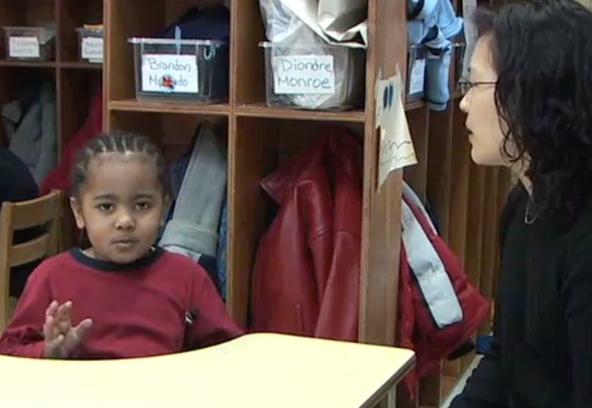
Well, that’s clear enough. An elevated insight.
On to our main hero in this Zen, Michael, age 5. Watch and listen to this video. What does he know about counting high?
I ask Michael to count. As the video begins, he has already counted correctly to fifty-four and continues from there.
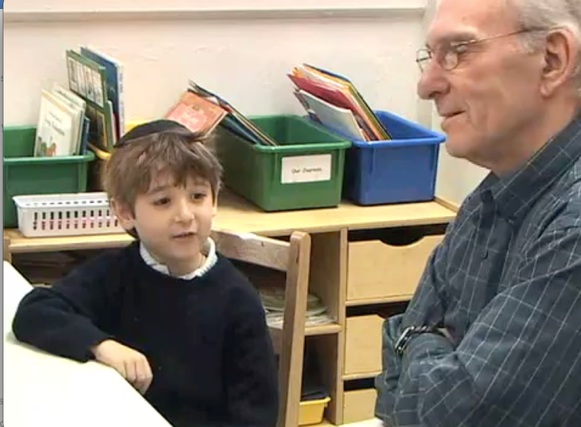
He counts correctly to sixty-nine, drawing out the “niiiiiine,” and then pauses. Thinking that he did not know the next number, I then say, “What’s next? What’s after six?” Why did I ask that question?
Here’s a little background. English speaking children have to memorize the first 12 numbers. But after that, counting becomes rule based. Each of the decade numbers (20, 30, 40, 50, 60, 70, 80, 90) refers to a specific number of 10s. 20 is 2 10s; 30 is 3 10s; 40 is 4 10s; and so on. The spoken number words sound more or less like the number of 10s they represent. In each case, the ty part of the number word indicates the tens (and sounds a little like ten) and the first part of the word is more or less like the number words from two to nine. Some numbers are very clear. Thus, forty, sixty, seventy, eighty, and ninety clearly include the numbers four, six, seven, eight, and nine. Thir in thirty resembles three, and fif resembles five. Twenty is weird: it should be twoty.
Back to the video. I said “What’s next? What’s after six?” because I was referring to the number of tens. “Seven tens” comes after “six tens.” But Michael does not get the tens hint. In response, I change it: “We say forty, fifty, sixty…” with emphasis on the first syllable, which gives the number of 10s. He gets seventy correct. We go through the routine again when he needs my hint to come up with eighty, and also ninety. At the end, when we have run out of tens, I give him the one and he replies hundred.
In brief, Michael has a pretty good grasp of the base ten system of number words, but he requires some hinting, some scaffolding. He does not need me to instruct, to give him the answer; he comes up with it himself.
We continue talking about numbers greater than one hundred. He cites the example of one hundred and one Dalmatians, a movie, and goes on from there. But the part on which I want to focus is his definition of zero, which is as interesting as Jack’s definition of counting high.
It’s always nice to have a little math humor.
What should we make of this?
- Children’s counting, at least beginning with the spoken number twenty, is rule based. Eventually they learn, at least implicitly, that the decade numbers (twenty, thirty…) start with some form of the unit numbers (one, two…nine).
- They also learn, at least implicitly, that after each decade number (twenty, thirty…) come the unit numbers one, two…nine in order.
- The hinting method can help children appreciate these rules and use them to generate the correct counting numbers.
Overall Zen insight:
To count correctly, children must memorize the spoken numbers one to twelve. But after that point, counting is rule governed.
Here are some tips for helping:
- Use counting books and songs to promote memorization of the first 12 English number words. Find some counting books here.
- DREME has many other resources related to counting words and things. Check them out here.
- Link the unit number words to the corresponding tens words. “Twenty is two tens; thirty is three tens” After that, hinting that stresses the base ten system underlying the counting words can be very effective in helping children see the pattern.
- Once they are pretty good at counting by tens, you can ask questions that stress the base ten system, such as “what is twenty plus two more?”
Finally, here is some teacher, adult-student, and parent homework: Whoever designed the English counting numbers from eleven to nineteen was confused. Do you know why? What should those numbers be?
[Hint: Ten-one…]
If you require guidance in this matter, you may contact my sensei, Professor Ginsboo, at profginsboo@gmail.com, who will emerge to respond.

More finally: Want to learn more about children’s understanding of counting? See Anna’s remarkable ideas in chapter 17 in my video book, Young Children’s Amazing Math (2025). Also, check out chapter 18 describing my Perfect English Counting System (PECS).
Wait! Not finished yet. My sensei informs me that a former Kindergarten teacher, Julie Diamond, has important comments on the Michael episode. Here they are:
| To help children learn number patterns, teachers can integrate them into routine class activities like transitions. For example, as a class is lining up to exit the room and children are waiting for the stragglers, the teacher can start counting by tens: “Ten, twen-ty, thir-ty, for-ty, fif-ty…” up to “one hundred,” proclaimed with a sense of victory. Emphasizing the first syllable provides a rhythm and also establishes the numerical structure of tens. Adding a clap or other motion offers variety. Harder patterns can gradually be substituted: “Five! Ten! Fif-teen! Twen-ty! Twenty-five! Thir-ty!…” Not all children will be able to repeat the entire pattern, but more and more will join as they gain familiarity with the chant. It can also be done as call-and-response, with the teacher saying the first number and then pointing to the class to supply the next. Using chants not only provides a focus during transitions but also promotes memorization of the tens and highlights the base ten structure underlying the counting numbers. |