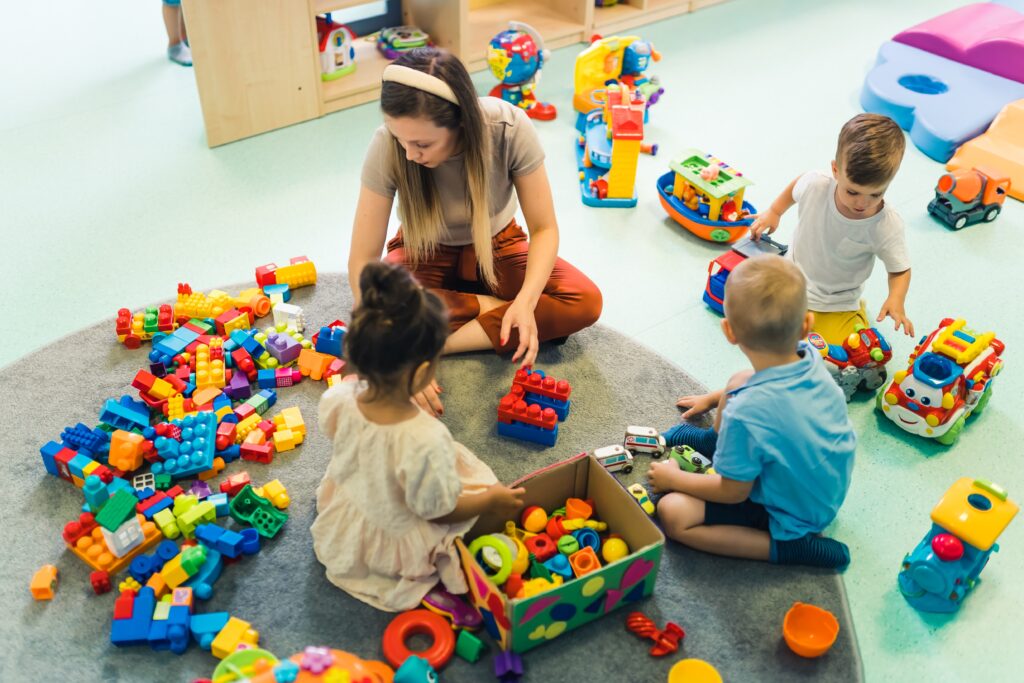
Early childhood classrooms are full of opportunities for math learning. Children have the chance to create meaningful math experiences in something as simple as building blocks to playmats. Still, many preschool teachers find that teaching math is intimidating, often reduced to rote counting or number recognition in preparation for kindergarten.
Researchers from the DREME Network decided to explore a different approach.
Partnering with teachers in community-based and nonprofit preschool settings, including Head Start programs, the team tested a collection of math activities designed to fit into existing classroom routines. Unlike scripted curricula that require new materials or rigid implementation, these activities—13 Center Activities and 22 “Math Moments”—were built to integrate into both centers and transitions, using materials teachers already had on hand. Teachers were able to choose which activities to use, how many to implement, and when to introduce them.
At the start of the study, 36 preschool teachers across four states completed a survey about their feelings toward teaching early math. Over the course of the school year, they completed monthly logs on their activity use and participated in interviews to capture how implementing these activities worked in their respective classrooms. At the end of the year, they completed a final survey reflecting on their experiences and described which activities were most successful and what challenges emerged.
Despite the modest sample size, the shifts in teacher perception were striking. Teachers reported significant increases in their confidence teaching early math, in their ability to help students learn math, and in how engaged they perceived their students to be during math experiences.
Nearly all teachers (97%) said the activities were easier to implement or comparable to other math curricula they had used. A small subset reported difficulty finding time to implement Center Activities (24%) or Math Moments (18%), underscoring the ongoing time pressures in early childhood classrooms. Still, every teacher agreed that the activities aligned with their curriculum or learning standards, and all agreed that they offered valuable new math opportunities for their students. Importantly, 64% reported that children were spending more time engaged in math each day compared to before the study.
In many of the community preschools, children as young as three participated in activities originally designed for four and five-year-olds. While teachers faced initial challenges adapting tasks for younger learners, they also observed unexpected results: older children stepped into leadership roles, guiding their younger peers and thus deepening their own understanding of math concepts in the process. Other teachers noted that introducing concepts such as addition or measurement required additional effort, but ultimately expanded the range of math experiences in their classrooms.
Perhaps most powerful were the shifts in mindset teachers described.
Several reported realizing that math instruction did not have to look like worksheets or drills. As one teacher shared, teaching math doesn’t have to mean “sit down and write your numbers” or rely on rote learning. There are different, equally effective ways to engage children; ways that feel like play and exploration.
Others emphasized that meaningful math learning doesn’t have to mean investing in expensive materials. Preschool classrooms already contain everything children need to engage with math: blocks for exploring measurement and balance, manipulatives for patterning, everyday objects for comparing “heavier” and “lighter.” For some teachers, the experience opened their eyes to new ways to approach early math. They reflected that preschool math often focuses on counting and number recognition in the name of kindergarten readiness. But children are also capable of engaging with patterning, comparison, addition, and other foundational concepts if given the opportunity.
Teachers also reported a deeper appreciation of their students’ capabilities. One remarked that the experience revealed children “know a lot more than I even give them credit for.” Activities were structured in ways that allowed children to lead, which increased engagement and ownership. When children could be “in charge,” they were more likely to choose these math experiences over simpler activities.
The guidebooks also supported more intentional instruction. Teachers noted that the built-in modifications for activities—such as using fewer cards for younger children or adjusting questioning strategies—helped them adapt their teaching strategies based on age and skill level. Rather than assuming one activity would fit all learners, they tended more to individual needs.
These findings echo prior research with public pre-K teachers. In community and Head Start settings, educators likewise found the activities relevant, practical, and complementary to existing curricula. Rather than replacing current math programs, the approach enhanced them by introducing more frequent and varied math opportunities throughout the day.
The takeaway is clear: supporting teachers with flexible, embedded math activities may be a promising strategy for increasing both the quantity and quality of early math experiences. When math is fit into daily routines, and when teachers feel confident supporting it, children can tap into richer mathematical thinking.
As a next step, researchers are conducting a small efficacy study to see whether this approach yields measurable increases in math opportunities compared to business-as-usual instruction, and whether those opportunities translate into advancements in children’s math knowledge.
Early evidence suggests that teaching math in preschool does not have to be difficult or disconnected from play. With the right support, it can be deeply aligned with how young children learn best.